When the Same Post Wins on One Network and Dies on Another
The launch announcement looked harmless. The team had written a concise product update, attached the same graphic, and sent it to LinkedIn and X. On LinkedIn, the post stalled at 40 impressions. On X, the same copy collected 12,000 impressions overnight.
That outcome doesn't prove that X was the better channel. It shows that the message matched one network's communication pattern and missed another's. The copy used a short, punchy hook, compressed context, and a direct link. X rewarded the cadence because the post read like a conversational update. LinkedIn needed more context, a clearer professional implication, and a stronger reason for readers to stop scrolling.
The failure happened before scheduling. The team treated every destination as a rendering target, not as a distinct publishing environment.
Cross-posting means publishing the same information across two or more online social networks. Research on 1,000 professional accounts found that the behavior is structured by platform role, timing, and content type rather than distributed uniformly, as described in the cross-network publishing analysis. That distinction matters to engineers because a single source payload can produce several valid delivery variants.
A news-media dataset reinforces the point. Researchers examined 676,779 posts from 53 outlets, together with more than 31 million comments and more than 840 million likes, across Facebook, Instagram, Twitter, and YouTube. Their findings showed that strong engagement on one platform doesn't guarantee strong engagement on another, even when publishers reuse similar posts, as reported in the large-scale audience engagement study.
Practical rule: Treat each network as a separate delivery target, even when every variant comes from the same core idea.
The artifacts that make this manageable are straightforward: a canonical asset, a variant map, and normalized analytics. The canonical asset preserves the source of truth. The variant map records what changes for each destination. Normalized analytics connects every result back to that source without collapsing different network behaviors into one misleading average.
Building the Canonical Post and Variant Map
Start with structured data, not a blank caption field. A canonical post should contain the message that must remain consistent across destinations, while leaving presentation choices to downstream variants.
Step one, define the source of truth
Capture these fields in the canonical record:
Canonical ID: A stable identifier that never changes when you edit a platform variant.
Hook: The opening idea or attention trigger.
Core claim: The single product, insight, or announcement being distributed.
CTA: The action you want the audience to take.
Asset URL: The master image, video, or document.
Tracking parameters: A consistent campaign and source taxonomy.
Approved status: Whether the content can enter the publishing queue.
The canonical record shouldn't contain four different captions. It should hold the approved idea and the references required to generate or review variants.
Step two, map each destination
Create one variant object per network. Store the rewritten caption, selected media crop, link destination, tracking parameters, hashtag set, and publishing state. A JSON-shaped model might look like this conceptually:
| Field |
Canonical |
LinkedIn variant |
X variant |
Instagram variant |
| Message |
Product update |
Professional explanation of the update |
Short conversational announcement |
Visual-led announcement |
| Caption |
Core claim and CTA |
Longer context and business relevance |
Compact hook and reply prompt |
Caption supporting the creative |
| Media |
Master asset URL |
Landscape or square adaptation |
Image or video attached to the post |
Feed or vertical adaptation |
| Link |
Campaign URL |
Tracked destination link |
Tracked destination link |
Profile or supported link path |
| Hashtags |
Approved topic terms |
Selective professional terms |
Minimal topical tags |
Platform-specific discovery terms |
The canonical ID should be copied into every variant record as a foreign key. That one relationship lets you answer basic operational questions later: which platforms received this asset, which variant was published, and whether a retry created a second post.
Step three, preserve the relationship
A product update might use the same core claim in four different ways:
LinkedIn: Explain what changed, why it matters to a professional audience, and invite discussion from practitioners.
X: Lead with the change, use a conversational sentence, and keep the call to action compact.
Instagram: Let the visual carry the first impression, then use the caption for context and discovery terms.
Threads: Use a text-first version that doesn't depend on a link in the post body.
That is adaptation, not message drift. The comparison of Postiz alternatives is useful when evaluating whether your publishing layer can preserve shared content relationships while allowing per-network edits.
The failure mode is free-form copy-paste. Once someone duplicates text into separate dashboards and edits it manually, the source relationship disappears. Your analytics become difficult to join, duplicate detection becomes unreliable, and a correction to the canonical message may not reach every destination.
A cross-posting pipeline fails at the edges. The message may be correct, but the caption can be truncated, the creative can be cropped badly, or the link can lose attribution when a platform handles it differently.
Use a reference table during content preparation rather than relying on memory. The limits and behaviors below come from the supplied platform guidance, but they should still be validated against current platform documentation before implementation because platform rules change.
| Network |
Caption limit |
Best aspect ratio |
Link behavior |
Hashtag norm |
| X |
280 characters |
16:9 for many media posts |
External links can need supporting media and may receive weaker distribution |
1 to 3 |
| Threads |
500 characters |
Square or portrait creative where relevant |
Text-first posts can work without a link |
Selective |
| LinkedIn |
3,000 characters |
16:9, 1:1, or 4:5 |
Link previews and third-party links need review |
1 to 3 |
| Facebook |
63,206 characters |
1:1 for many feed assets |
Link previews depend on the destination and attachment |
Selective |
| Instagram |
2,200 characters |
4:5 for feed, 9:16 for Stories and Reels |
Caption links aren't the same as profile or supported link paths |
Up to 30, with 8 to 15 often treated as a practical range |
Caption constraints change the edit
A LinkedIn version can carry explanation that would overwhelm X. An X version needs a sharper opening because the available text is constrained. Instagram often needs the media to establish context before the caption earns attention. Threads can support a text-only treatment where the link is intentionally omitted.
Don't solve this by truncating the canonical caption. Write a proper variant. A truncated paragraph usually loses the claim's setup, while a short rewrite preserves the point.
Maintain separate media references for square, portrait, and vertical formats. A mobile-recorded vertical video may flatten or crop unexpectedly when it's passed through a feed composer that expects another shape. Link previews can also change between networks, and an external URL without supporting media may not behave like a complete native post on X.
Hashtags require the same treatment. A small, relevant set may look intentional on LinkedIn or X, while Instagram can support a broader discovery-oriented set. The variant map should make those choices explicit so nobody has to guess during scheduling.
Mentions and threads are stateful
A mention may fail if the destination account uses a different handle. A threaded post needs ordering, parent-child references, and reconciliation for every published item. Treat those fields as part of the variant, not as decoration added after dispatch.
Scheduling, Queues, and Rate Limits in Practice
A reliable cross-post queue starts with a job object that describes intent, not just text. It should reference the canonical post, variant map, target networks, scheduled timestamp, and current delivery state.
Isolate each network queue
Fan the job into per-network queues after validation. A rate-limit spike on one platform shouldn't block unrelated deliveries elsewhere. Each queue needs its own worker, retry counter, platform response, external post ID, and last-attempt timestamp.
Use a flow like this:
Ingest the job and confirm that the canonical record is approved.
Validate variants against caption, media, link, mention, and destination requirements.
Check queue capacity and current rate-limit state.
Dispatch independently to each selected network.
Reconcile delivery using the returned post ID or a verified webhook event.
Back off without creating duplicates
When an API returns a 429 response, use exponential backoff with jitter. The delay should increase between attempts, while random jitter keeps many workers from retrying at exactly the same moment. Store the attempt state so a process restart doesn't reset the retry schedule.
A dead-letter queue handles jobs that exceed the maximum retry policy. Do not discard them without notification. Give operators the canonical ID, target network, error class, attempts, and suggested action.
A queue that supports retries and rate-limit backoff is one reason teams compare unified publishing layers with the Bundle alternative for social APIs. The architectural requirement matters more than the brand: failures need to remain visible and recoverable.
Schedule in UTC, publish in local windows
Store the authoritative timestamp in UTC, then calculate each network's local publishing window from the audience and account configuration. Don't assume one global slot works across every destination. Audit daylight-saving changes, account time zones, and staggered variants so followers who subscribe to several channels don't see the same announcement simultaneously.
Silent drops need their own detection path. Reconcile the expected destination list with returned post IDs, verify webhook events when available, and query the platform after dispatch if confirmation is missing. A fallback republish path must check for an existing matching canonical ID before creating another post. Blind retries are how one launch becomes two identical posts.
Measuring Cross Posting Performance the Right Way
Raw likes and impressions are useful within a network, but they're weak comparison tools across networks. An impression is reported through a platform-specific measurement system, and an interaction on LinkedIn doesn't carry the same audience meaning as an interaction on TikTok.
Build an analytics schema that preserves both the shared source and the destination context. A practical record includes:
post_id: The canonical ID, used as the foreign key.
network: The destination platform.
platform_post_id: The native post identifier.
interaction_type: An enum such as impression, like, comment, share, view, or click.
event_value: The reported count or value.
network_reach_factor: A calibration field based on that platform's average reach.
utm_status: Whether tracking parameters survived publication and redirection.
captured_at: The time the metric was collected.
Calculate engagement rate against impressions where the network exposes compatible data, rather than dividing interactions by follower count. Keep conversion attribution separate from engagement attribution. A link may preserve UTMs on one destination and lose them on another, so your conversion table should record whether the click was directly attributable, indirectly attributable, or unattributed.
A worked comparison
Use a fictional operational example without treating the values as industry evidence:
| Network |
Raw Impressions |
Raw Likes |
Engagement Rate |
Normalized Score |
| LinkedIn |
1,000 |
60 |
6% |
1.00 |
| X |
5,000 |
125 |
2.5% |
0.72 |
| Instagram |
2,000 |
80 |
4% |
0.86 |
The raw winner is X because it reports the largest impression count. The rate-based view favors LinkedIn because more of its measured audience interacted. A normalized score can add reach calibration and conversion quality, but you must define that formula before looking at the result. Don't invent a weighting system after seeing which platform you want to win.
Cross-platform benchmark summaries show why this discipline matters. One 2026 analysis of more than 52 million posts reported typical engagement clustering around 6.2% for LinkedIn, 5.6% for Facebook, and 5.5% for Instagram, while another set of 2026 benchmark summaries reported approximately 3.7% for TikTok, 0.48% for Instagram, 0.15% for Facebook, and 0.12% for X, as compiled in Buffer's 2026 engagement analysis. These figures shouldn't be merged into one universal benchmark. They demonstrate that destination-specific baselines are essential.
Choosing Where to Actually Publish
Broadcasting to every connected account feels efficient, but it often creates more operational noise than distribution value. Guidance on cross-posting recommends focusing on 3 to 6 relevant platforms and adapting the caption, image, tone, and hashtags for each destination, as described in current cross-posting guidance.
Use four questions before adding a network:
Audience fit: Does the account reach people who can use or share this message?
Format fit: Can the team produce a native version without forcing the asset into an unsuitable format?
Cadence capacity: Can someone monitor replies, mentions, and failed deliveries there?
Measurement priority: Can the team connect activity on that network to a meaningful business outcome?
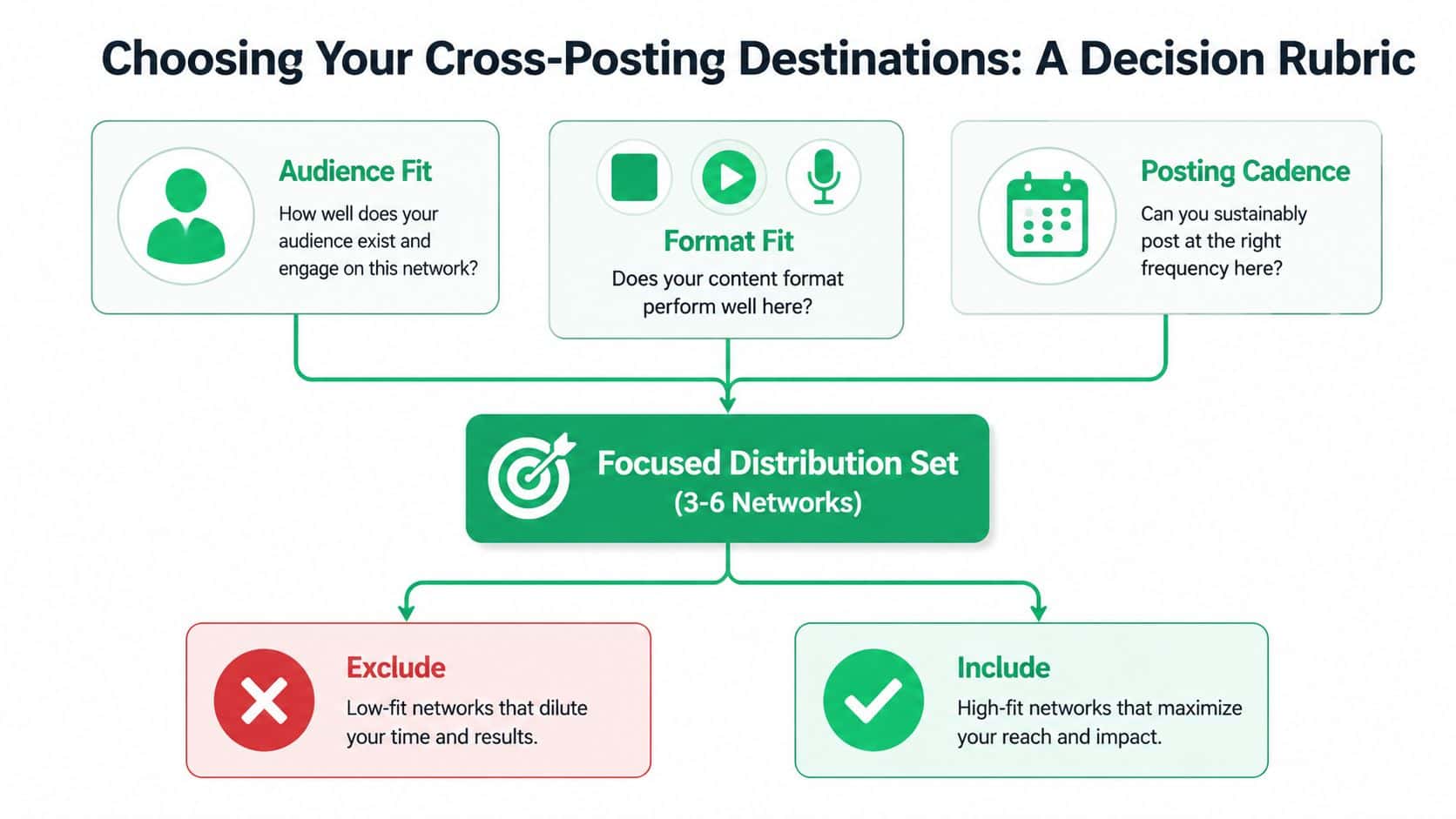
Tier the result. Primary networks receive the canonical campaign by default. Secondary networks receive it when the topic and format fit. Experimental networks receive it only when the team has enough bandwidth to create a genuine variant and inspect the results.
Duplicate-content fatigue is the risk behind indiscriminate distribution. Followers who see the same link and wording across several accounts may tune out instead of feeling better informed. Stagger timing, change the CTA, and give each network a reason to exist. A unified publishing workflow such as the Ayrshare alternative for multi-network distribution can support the mechanics, but the selection decision still belongs to the content and product teams.
Your Cross Posting Checklist Before You Hit Schedule
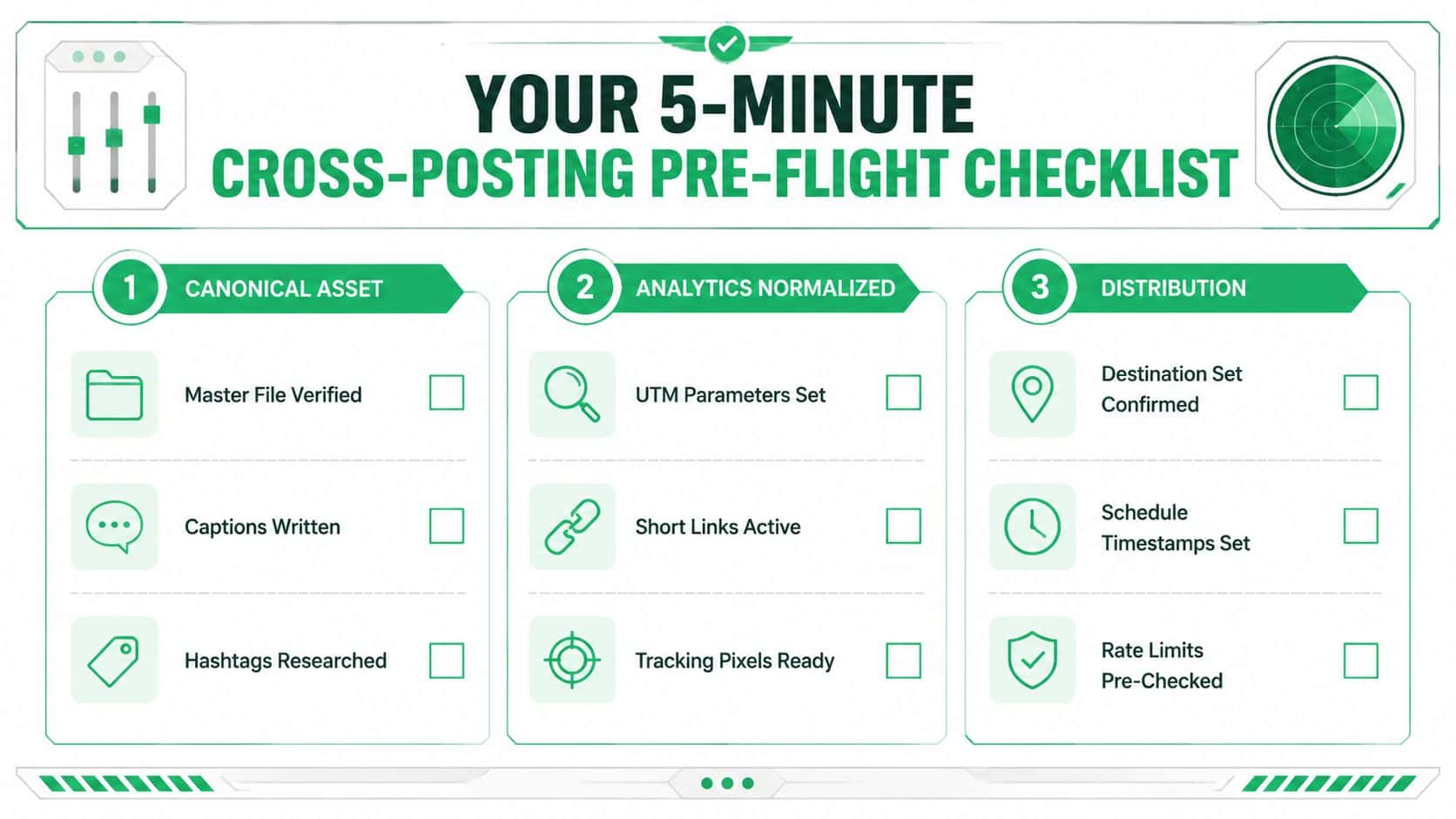
Treat the checklist as a runtime guard. Each item should prevent a failure that would otherwise surface after publication.
Message integrity
Canonical ID assigned: Every variant points back to one approved source record.
Core claim preserved: Each rewrite communicates the same product or editorial truth.
CTA reviewed: The requested action matches the destination's link and interaction model.
Master asset verified: The source file opens, renders, and belongs to the approved campaign.
Caption rewritten: No destination receives an accidental copy-paste of the canonical text.
Media crop selected: Use the intended square, portrait, or vertical asset.
Links checked: Confirm previews, redirects, and UTM parameters before scheduling.
Mentions validated: Handles, thread order, and parent references are ready.
Scheduling hygiene
UTC timestamp stored: Local publishing windows are derived from a single authoritative time.
Destination set confirmed: Excluded, secondary, and experimental networks are intentional.
Queue isolation tested: One platform's rate limit can't pause every other worker.
Duplicate check enabled: A retry searches for an existing platform post ID or canonical match.
Measurement readiness
Post IDs captured: Store the native ID returned by each successful dispatch.
Event types normalized: Likes, comments, views, clicks, and impressions map to known fields.
Attribution status recorded: Mark whether UTMs survived or conversion data is indirect.
Failure alerts active: Missing confirmations and dead-letter jobs reach an operator.
Teams often skip canonical ID assignment and deduplication verification because neither appears in the final post. Those omissions create the worst reporting and recovery problems. A short pre-flight review turns cross posting from a hopeful broadcast into a repeatable publishing system that can be audited after every campaign.
Bulkit provides one API for publishing, scheduling, webhooks, queue status, and normalized analytics across major social networks, so your team can connect canonical posts to platform-specific variants without maintaining separate integrations. If you're building a multi-network product workflow or automation pipeline, visit Bulkit to review the API, SDK, CLI, n8n node, and MCP server.